
Mental Health Risk Assessment Tool
Understand Your Risk Factors
This tool helps you understand how family history relates to mental health risks based on scientific research. Remember: Genes are not destiny—environment and lifestyle play equally important roles.
What Your Results Mean
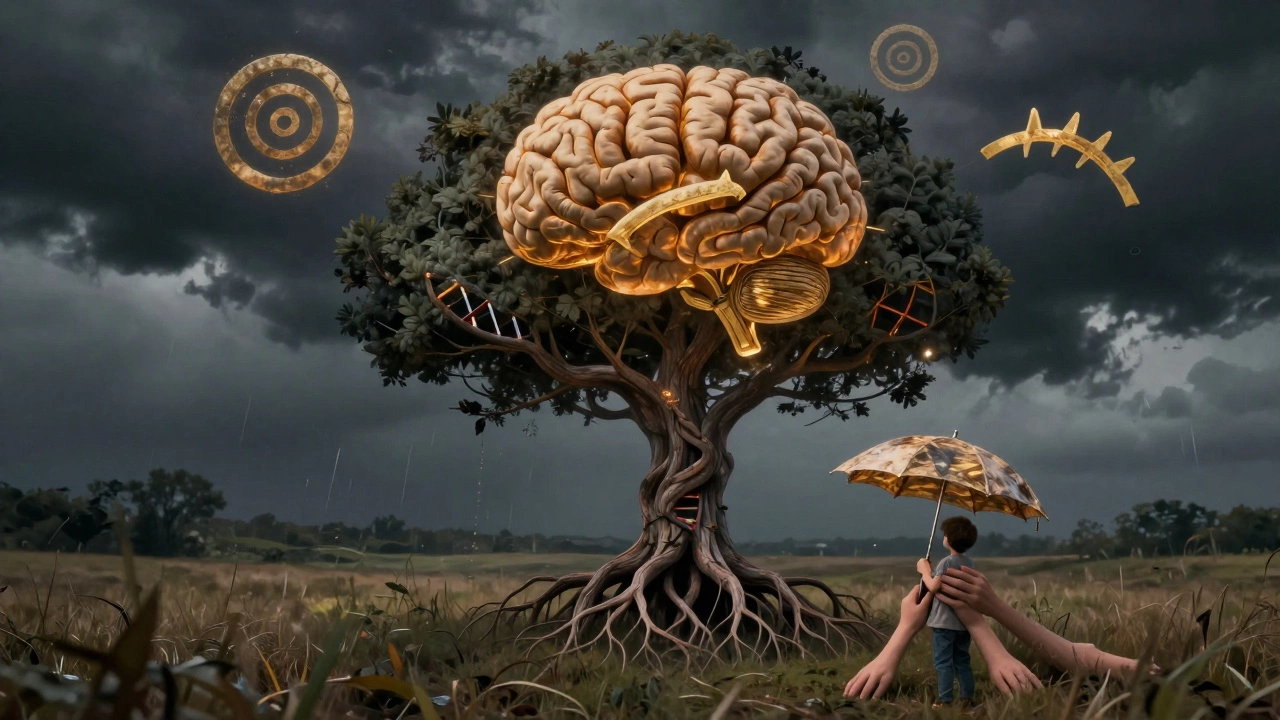
When someone in your family struggles with depression, anxiety, or psychosis, it’s natural to wonder: is this something I could inherit? The idea that mental illness runs in families isn’t just a feeling-it’s backed by decades of research. But it’s not as simple as inheriting a disease like cystic fibrosis. Mental illnesses don’t come from a single broken gene. They’re shaped by dozens, sometimes hundreds, of small genetic changes working together with life experiences. If you’re asking what mental illnesses are genetic, the answer isn’t a list of diagnoses-it’s a map of risk, not destiny.
Depression and the role of inherited risk
Major depressive disorder affects over 280 million people worldwide. Studies of twins show that if one identical twin has major depression, the other has a 40% to 50% chance of developing it too. That’s far higher than the 10% to 15% risk in non-identical twins or the general population. But here’s the catch: if genetics were the whole story, the rate would be closer to 100%. It’s not. That means genes load the gun, but environment pulls the trigger.
Researchers have identified over 100 gene variants linked to depression, each with a tiny effect. One of the most studied is the serotonin transporter gene (5-HTTLPR). People with two short versions of this gene are more likely to develop depression after stressful life events-like losing a job, going through a divorce, or experiencing trauma. But if they grow up in a stable, supportive environment, their risk drops to near average. This isn’t about being ‘doomed’ by your DNA. It’s about how your genes interact with your life.
Bipolar disorder: Stronger genetic signals
Bipolar disorder shows one of the strongest genetic links among mental illnesses. If one parent has bipolar disorder, a child has about a 10% to 25% chance of developing it. If both parents have it, that risk jumps to 30% to 50%. In identical twins, the chance of both having bipolar disorder is between 60% and 80%. That’s among the highest heritability rates seen in psychiatric conditions.
Genome-wide studies have found specific gene clusters tied to bipolar disorder, especially those involved in brain cell communication and circadian rhythms. People with bipolar disorder often have disruptions in sleep-wake cycles, and some of the same genes that regulate body clocks also affect mood stability. This explains why sleep loss can trigger manic episodes in those genetically vulnerable. But again-not everyone with these genes develops the illness. Stress, substance use, and major life changes often act as the spark.
Schizophrenia: A complex web of genes and environment
Schizophrenia is one of the most misunderstood mental illnesses, and its genetic side is no exception. About 1% of the population develops it. If a sibling has schizophrenia, your risk rises to 10%. If a parent has it, it’s 13%. If both parents have it, the risk climbs to nearly 50%. These numbers are high, but they’re not guarantees.
Over 200 gene variants have been linked to schizophrenia, many involved in how the brain forms connections during development. One of the most important is the DISC1 gene, first discovered in a Scottish family where a single mutation led to high rates of psychosis, depression, and bipolar disorder across generations. But even in that family, not everyone with the mutation got sick. Environmental factors like prenatal infections, childhood trauma, or heavy cannabis use during adolescence can push someone over the edge-if their genes make them vulnerable.
Other conditions with clear genetic ties
Autism spectrum disorder (ASD) has strong hereditary patterns. If one identical twin has autism, the other has a 60% to 90% chance of also being diagnosed. Siblings of children with ASD have a 10% to 20% increased risk compared to the general 1.5% rate. While no single gene causes autism, hundreds of rare mutations and common variants add up to increase susceptibility.
Obsessive-compulsive disorder (OCD) also runs in families. Children of parents with OCD are five times more likely to develop it than those without a family history. Studies point to genes involved in serotonin regulation and brain circuits that control fear and habit formation.
Anorexia nervosa, once thought to be purely about culture or control, now shows strong genetic links. Twin studies suggest heritability is around 50% to 60%. Specific genes tied to metabolism, appetite regulation, and anxiety are involved. This isn’t about vanity-it’s biology.
What genes don’t tell you
It’s easy to think that if your family has mental illness, you’re destined to have it too. But that’s not how it works. Genetics gives you a risk profile-not a diagnosis. Think of it like heart disease: having a family history means you should pay attention to diet, exercise, and stress. It doesn’t mean you’ll have a heart attack at 30.
Even in families with multiple cases of schizophrenia or bipolar disorder, many people never develop symptoms. Protective factors matter just as much as risk factors. Strong social support, good sleep, regular physical activity, and avoiding drugs like marijuana or stimulants can reduce risk significantly. Therapy, especially cognitive behavioral therapy (CBT), can help rewire how the brain responds to stress-even in people with high genetic risk.
And here’s something important: many people with mental illness have no family history at all. Environmental trauma, chronic stress, brain injury, or even long-term illness can trigger conditions in people with low genetic risk. Mental health isn’t a family inheritance-it’s a conversation between your genes and your life.
Genetic testing: Useful or misleading?
You might see ads for DNA tests that claim to predict your risk for depression or anxiety. These are not reliable. Most of them look at just one or two gene variants and give you a vague percentage. That’s like checking the weather forecast based on one cloud in the sky.
Real genetic research uses data from hundreds of thousands of people and looks at thousands of markers. Even then, these tools can’t tell you if you’ll get sick-they only show relative risk compared to the average person. Right now, no genetic test can diagnose or predict mental illness in an individual. They’re useful for research, not personal decisions.
If you’re concerned about your family history, talk to a mental health professional or genetic counselor. They can help you understand your actual risk and what steps you can take to protect your mental health.
What you can do with this knowledge
Knowing your family history isn’t about fear-it’s about awareness. If depression runs in your family, you might pay closer attention to your mood patterns. If anxiety or OCD is common, you might learn coping skills early. If psychosis is present, you might avoid cannabis during your teens and twenties, when the brain is most vulnerable.
You can also help break the cycle. Early intervention works. If a child shows signs of emotional struggles, therapy, school support, and stable routines can reduce the chance of a full-blown illness later. Mental health care isn’t just for those who are already sick-it’s for those at risk, too.
The science is clear: genes matter. But they don’t control your life. Your choices, your environment, your relationships-those matter more.
Can you inherit depression from your parents?
Yes, depression has a genetic component. If a parent has major depression, your risk is about double that of someone without a family history. But genes alone don’t cause it. Stress, trauma, lifestyle, and social support play just as big a role. Many people with a family history never develop depression, and many without it do.
Is bipolar disorder genetic?
Bipolar disorder is one of the most heritable mental illnesses. If one parent has it, your risk is 10% to 25%. If both parents have it, the risk jumps to 30% to 50%. Identical twins have a 60% to 80% chance of both having it. But again, not everyone with the genes develops the illness-environment and life events are key triggers.
Can schizophrenia be passed down in families?
Yes. If one parent has schizophrenia, your risk is about 13%. If both parents have it, the risk is nearly 50%. Identical twins have a 40% to 65% chance of both being affected. Hundreds of genes are involved, and environmental factors like prenatal infection, childhood trauma, or cannabis use during adolescence can increase risk in genetically vulnerable people.
Do anxiety disorders run in families?
Yes. Anxiety disorders-including generalized anxiety, panic disorder, and social anxiety-tend to run in families. Children of parents with anxiety are two to three times more likely to develop it. Studies suggest heritability is around 30% to 40%. But upbringing, stress levels, and coping skills can greatly reduce or increase that risk.
Is there a genetic test for mental illness?
No reliable genetic test exists for any mental illness. Commercial DNA tests that claim to predict depression or schizophrenia are based on incomplete science. They look at a few gene variants and give misleading risk estimates. Real research uses huge datasets and still can’t predict individual outcomes. Genetic testing isn’t useful for diagnosis or prevention right now.
Next steps if you’re worried about your risk
If mental illness runs in your family, start by learning your history. Talk to relatives. Know what conditions they’ve had and at what age. This isn’t about guilt or fear-it’s about awareness.
Build habits that protect your brain: get enough sleep, move your body regularly, limit alcohol and drugs, and stay connected to people you trust. If you notice changes in your mood, thoughts, or behavior, don’t wait. Talk to a doctor or therapist early. Prevention is always better than crisis.
And remember: having a genetic risk doesn’t mean you’re broken. It just means your brain might need a little extra care. That’s not weakness. That’s wisdom.