
After-School Activity Finder
Define Your Goal
Key Details
- ✓ Focus:
- ✓ Typical Location:
- ✓ Cost Structure:
Select a goal above to find the right activity name.
Ever watched a kid sprint out of the school gates at 3:00 PM and wondered where they were heading next? Chances are, they weren’t going straight home to play video games. They were likely rushing to a soccer practice, a robotics workshop, or a drama rehearsal. But what do we actually call these organized sessions that happen once the final bell rings?
The short answer is that there isn't just one name. Depending on who you ask-a teacher, a parent, or a child-the term changes. You might hear extracurricular activities, which is the formal educational term for non-academic pursuits pursued by students outside the regular curriculum. Or maybe someone mentions "enrichment programs," "youth clubs," or simply "afterschool care." Understanding the difference between these terms helps parents find the right fit for their children’s interests and schedules.
The Umbrella Term: Extracurricular Activities
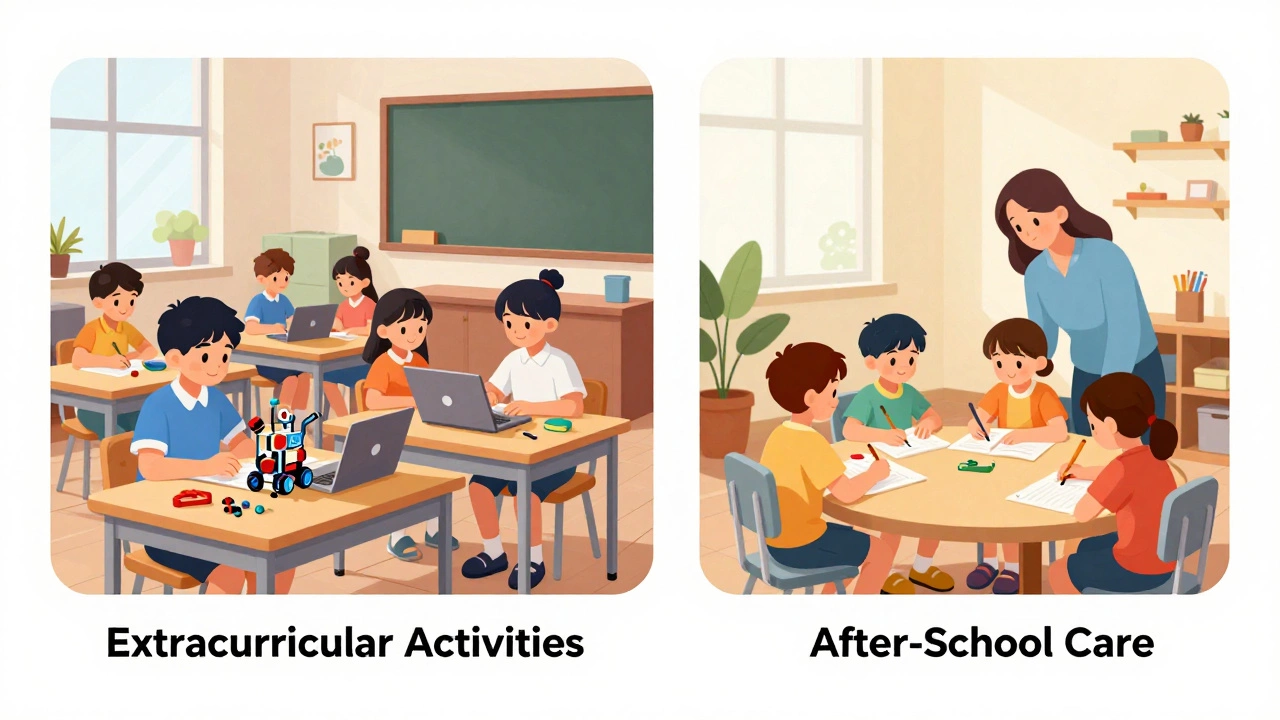
If you want to sound official, use the word extracurricular. This is the standard term used in schools, colleges, and resumes. It comes from Latin roots meaning "outside the course." These are activities that supplement the academic curriculum but aren't part of the graded classroom experience.
Extracurriculars generally fall into two buckets: school-sponsored and community-based. School-sponsored activities usually meet on campus during the school day or immediately after. Think of the debate team meeting in Room 104 or the choir practicing in the auditorium. Community-based activities happen off-campus, often at local centers, sports complexes, or private studios. A coding bootcamp at a library or a karate class at a gym fits here.
Why does the distinction matter? School-sponsored extracurriculars often tie directly into college applications and school spirit. Community-based ones tend to offer more specialized skills or higher-level competition. Both are valid, both are valuable, and both count as "activities" in the broad sense.
School-Based Names: Clubs, Teams, and Ensembles
When the activity happens within the school walls, the naming convention gets specific based on the nature of the pursuit. Here is how schools typically label them:
- Clubs: This is the catch-all for interest-based groups. If it’s not a sport and not a performance group, it’s probably a club. Examples include the Chess Club, Environmental Club, or Anime Club. Clubs are usually student-led with a faculty advisor overseeing the meetings.
- Athletic Teams: Sports have their own hierarchy. Intramural teams are for casual play within the school. Varsity teams represent the school in competitive leagues against other districts. Practice sessions are often called "team practices" rather than activities.
- Ensembles or Performance Groups: Music and theater students don't join "clubs." They join ensembles. The marching band, the jazz ensemble, the orchestra, or the drama troupe. These require auditions and rigorous rehearsal schedules, distinguishing them from casual clubs.
- Academic Competitions: Groups like Math Olympiad, Science Bowl, or Debate Team are often referred to as "competitive academies" or "honors groups" even though they function like clubs.
Community and Third-Party Names: Programs and Centers
Not all after-school action happens at school. Many parents turn to third-party providers for structured supervision and skill-building. In this sector, the terminology shifts toward service-oriented language.
You will frequently hear the term After-School Care (ASC), which refers to supervised childcare services provided before and after school hours, often including homework help and snacks. ASC is primarily about safety and supervision, though many modern centers integrate educational elements. If your main goal is ensuring your child has a safe place to go while you finish work, you are looking for ASC.
Then there are Enrichment Programs, which are specialized courses designed to enhance a student's knowledge or skills in a specific area beyond the standard curriculum. These are often run by nonprofits, community centers, or private companies. An enrichment program might focus solely on STEM (Science, Technology, Engineering, and Math) or arts. Unlike general ASC, enrollment in enrichment programs is usually selective and fee-based.
In New Zealand and parts of Australia, you might also hear the term "Holiday Care" or "Day Camp" when referring to intensive blocks of activities during school breaks, though these are distinct from daily after-school routines.
| Term | Primary Focus | Typical Location | Cost Structure |
|---|---|---|---|
| Extracurricular | Skill development & competition | School campus | Often free or low fee |
| After-School Care (ASC) | Supervision & safety | School or community center | Hourly or daily rate |
| Enrichment Program | Specialized learning (STEM, Arts) | Private studio or library | Per-term or per-class fee |
| Youth Club | Socialization & recreation | Community hall or church | Membership fee |
Why the Name Matters for Parents and Students
You might wonder why semantics matter. Why not just call everything "stuff kids do after school"? The label dictates the expectation, the structure, and the outcome.
If you sign up for After-School Care, you expect your child to be fed, supervised, and perhaps helped with homework. You do not necessarily expect them to learn advanced coding or win a regional trophy. If you sign up for an Extracurricular Sport, you expect commitment, physical exertion, and potential travel for matches. Mixing these up leads to frustration. A parent expecting academic tutoring from a recreational soccer coach will be disappointed. A student expecting a relaxed hangout in a high-pressure debate prep session will feel overwhelmed.
Furthermore, the terminology affects college and university applications. Admissions officers look for "extracurricular involvement" that shows depth and leadership. Casual attendance at a drop-in community center activity rarely carries the same weight as holding a presidency in a school club or captaining a varsity team. Knowing the difference helps students build a resume that reflects genuine engagement rather than just presence.
Trends in After-School Naming and Structure
The landscape of after-school activities is evolving. In recent years, we’ve seen a shift away from purely recreational labels toward competency-based titles. Instead of "Computer Club," many schools now offer "Digital Literacy Workshops" or "Robotics Engineering." This shift signals a move toward vocational preparation and soft-skill development.
Mental health awareness has also influenced naming. Activities that were once strictly social are now framed as "Wellness Groups" or "Mindfulness Circles." This destigmatizes participation and attracts students who might otherwise avoid traditional clubs due to social anxiety.
Additionally, hybrid models are emerging. Some organizations blend ASC with enrichment, calling them "Extended Learning Centers." These facilities provide basic care but allow students to opt into paid add-ons like music lessons or language classes. This model appeals to working parents who need reliability but also want their children to explore passions.

How to Choose the Right Label for Your Child
So, what should you call the activity you’re looking for? Start by defining the goal.
- Need Supervision? Search for "After-School Care" or "Childcare." Prioritize staff-to-child ratios and safety protocols.
- Want Skill Building? Look for "Enrichment Programs" or specific "Clubs." Check the curriculum and instructor qualifications.
- Seeking Competition? Ask about "Varsity Teams" or "Competitive Leagues." Understand the time commitment and travel requirements.
- Desiring Social Connection? Explore "Youth Clubs" or "Community Groups." Focus on the group size and inclusivity policies.
Don’t be afraid to ask questions. When you call a provider, ask: "Is this considered an extracurricular activity or supervised care?" Their answer will tell you exactly what kind of environment your child will enter.
Common Misconceptions About After-School Activities
One common myth is that all after-school activities are expensive. While private enrichment programs can cost hundreds of dollars per term, most school-based extracurriculars are heavily subsidized. Public schools often charge minimal fees for equipment or uniforms. Community centers also offer sliding-scale fees based on income. Never assume cost is a barrier without checking first.
Another misconception is that only high-achieving students benefit from extracurriculars. In reality, students struggling academically often thrive in after-school settings. The hands-on nature of clubs and sports provides alternative pathways for success and confidence building. A student who struggles with math might excel in woodworking or theater, finding a new sense of identity and peer support.
Finally, some parents believe that over-scheduling is necessary for future success. Research suggests that downtime is crucial. An empty hour after school allows for unstructured play, reflection, and rest. Balance is key. One or two meaningful activities are far better than five half-hearted commitments.
What is the difference between extracurricular and co-curricular activities?
The terms are often used interchangeably, but there is a subtle distinction. Extracurricular activities are completely separate from the academic curriculum (e.g., joining a chess club). Co-curricular activities complement the classroom learning directly (e.g., a science fair project related to biology class). For most parents and students, this distinction doesn't change the practical experience, but it matters in strict academic contexts.
Are after-school clubs mandatory?
In most public school systems, after-school clubs and sports are voluntary. However, some schools may require a minimum number of hours of community service or extracurricular participation for graduation. Private schools sometimes have stricter requirements regarding house points or team participation. Always check your specific school handbook.
What is the best age to start after-school activities?
There is no single "best" age. Younger children (ages 5-8) benefit from unstructured play and simple social clubs. As children reach ages 9-12, they can handle more structured enrichment programs and team sports. Teenagers (13+) are ready for leadership roles, competitive teams, and complex skill-building workshops. Follow the child's interest rather than a rigid timeline.
Do after-school activities help with college admissions?
Yes, but quality matters more than quantity. Admissions officers look for "spikes"-deep involvement in one or two areas-rather than a long list of superficial memberships. Leading a school club or achieving a high rank in a sport demonstrates dedication and leadership, which are highly valued traits.
How much do after-school programs cost?
Costs vary wildly. School-based activities often range from free to $100 per term for materials. Private enrichment programs can cost $200-$500 per term. After-school care centers typically charge hourly rates, averaging $10-$20 per hour depending on location. Scholarships and subsidies are often available through local councils and school administrations.