Volunteer Commitment Assessment
This assessment helps you evaluate if volunteering aligns with your current capacity. Answer honestly to identify potential risks before they become overwhelming.
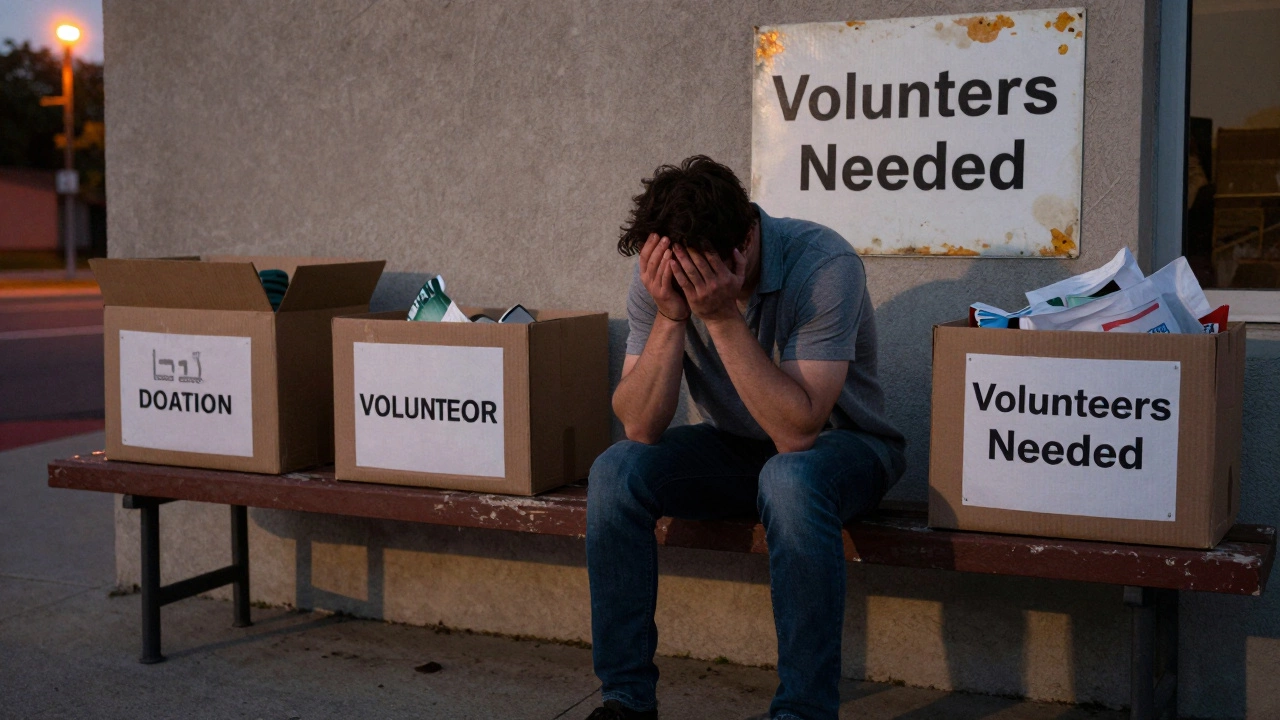
Volunteering feels good. You show up, you help out, you leave with that warm fuzzy feeling. But here’s something no one tells you: volunteering isn’t always sunshine and gratitude. It can be exhausting, frustrating, and even harmful-if you don’t know what you’re signing up for.
It eats your time without paying you back
You think you’re giving your time. But time is money, even when you’re not getting paid. A single weekend shift at a food bank? That’s eight hours gone. Add travel, prep, and recovery, and you’re looking at ten. Over a year, that’s 500+ hours. For someone working two jobs, caring for kids, or managing chronic pain, that’s not generosity-it’s sacrifice.And here’s the catch: no one asks if you can afford it. Organizations need bodies, not boundaries. You say you’re only available on Tuesdays? Great. Now you’re the only one who knows how to run the donation sorting system. When you take a break, the whole thing slows down. Guilt sets in. You start showing up even when you’re sick, because you don’t want to let people down.
Emotional burnout is real-and rarely discussed
Volunteering at a shelter, a hospice, or a youth program means facing pain you didn’t sign up to carry. You bond with a kid who gets kicked out of their home again. You hold the hand of someone who won’t wake up tomorrow. You pour your heart into a project that gets defunded next month.There’s no debrief. No counseling. No HR department checking in. You’re expected to be strong, cheerful, and always available. A 2023 study from the University of Auckland tracked 400 long-term volunteers in New Zealand. Nearly 60% reported symptoms of emotional exhaustion after 18 months. Half didn’t tell anyone. They thought it was just part of the job.
Some organizations exploit volunteers
Not all nonprofits are created equal. Some rely on volunteers to do work that should be paid. Think of it: a community center runs its entire front desk, event planning, and outreach program with volunteers-while the executive director earns $90,000 a year. Volunteers become the cheap labor that keeps the system running, while real staff roles stay unfilled.In Wellington, a group of volunteers at a youth outreach nonprofit walked out in 2024 after discovering the organization had received $1.2 million in government funding-but spent zero of it on paid staff. The volunteers were doing HR, accounting, and grant writing. No training. No supervision. Just expectations.

You’re often treated like a tool, not a person
Volunteers get handed clipboards, uniforms, and a list of rules. But rarely do they get a seat at the table. Decisions about what programs run, who gets help, and how resources are allocated? Those are made by paid staff or board members. Volunteers are expected to follow orders, not question them.One woman in Dunedin volunteered at a women’s shelter for three years. She noticed the same families kept coming back, often with the same issues. She suggested a trauma-informed intake system. The director thanked her and said, “We’ll look into it.” Nothing changed. She stopped going six months later. “I felt like a cog,” she told me. “Not part of the solution.”
The ‘helper’ identity can trap you
Volunteering can become a way to avoid your own problems. You pour energy into helping others because you don’t want to face your own loneliness, grief, or stagnation. It feels noble. It feels purposeful. But it’s a distraction.People who volunteer to escape personal pain often burn out faster. They don’t take breaks. They say yes to everything. They tie their self-worth to how much they give. When they finally step back, they feel empty-not proud. One man in Christchurch, who volunteered at a men’s mental health group for five years, told me he only realized he needed help himself when he couldn’t stop crying after every shift.
It doesn’t fix systemic problems
Volunteering at a food bank doesn’t stop inflation. Sorting clothes at a thrift store doesn’t fix housing shortages. Tutoring a child doesn’t fix underfunded schools. These are band-aids on bullet wounds.That’s not to say volunteering doesn’t matter. But if you think it’s changing the system, you’re kidding yourself. And when you realize that, it can be deeply disillusioning. You start asking: Why am I doing this? Is this really helping, or am I just making the problem feel less urgent?

You lose out on other opportunities
Time spent volunteering is time not spent on your career, your health, your relationships, or your hobbies. A 25-year-old volunteering 15 hours a week at a nonprofit might miss out on networking events, skill-building courses, or even a second job that could lift them out of debt.And let’s be honest: volunteering doesn’t always look good on a resume. Employers care about paid experience. They care about measurable results. A volunteer role with no clear outcomes-like “helped with events”-won’t move the needle. If you’re volunteering to boost your CV, you’re setting yourself up for disappointment.
The guilt cycle never ends
Once you start volunteering, it’s hard to stop. You feel guilty if you say no. You feel guilty if you take a week off. You feel guilty if you complain. You start thinking: Others are doing more. Others are working harder. Others are sacrificing more.But here’s the truth: you’re not a machine. You’re not obligated to give forever. And the people you’re helping? They don’t want you broken. They want you well. If you’re running on fumes, you’re not helping anyone-not really.
It’s okay to walk away
Volunteering should never cost you your peace. If you’re tired, resentful, or drained, it’s not a sign you’re failing. It’s a sign the arrangement isn’t working.You don’t need to justify your exit. You don’t owe anyone an explanation. You’re not a volunteer because you’re noble-you’re a volunteer because you chose to. And if that choice no longer serves you, walk away.
There’s no medal for martyrdom. The best thing you can do for the cause is to take care of yourself first. Then, if you come back-fresh, rested, and whole-you’ll actually make a difference.